Donald Roy
The Wisdom of CrowdsDonald Roy was a sociologist whose account of working in a machine shop showed how a pay system designed to reward productivity could instead encourage workers to limit it. His experience as a lathe operator made the gap between formal incentives and actual behavior concrete: when faster work risked raising the production targets, workers had reason to manage the targets rather than simply produce more.
Identity and Background
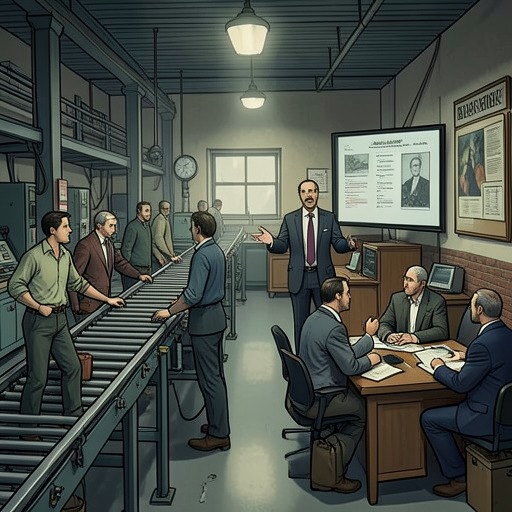
In the early 1950s, Roy took a job as a lathe operator in a machine shop. He later described the experience in an article titled “Goldbricking in a Machine Shop.” The account serves as an observed workplace case: Roy encountered the incentive system as a worker and examined how its rules shaped the choices of the people subject to them.
The Piece-Rate System
The operators were paid according to a piece-rate incentive system. They began at one rate per piece; after reaching a target, the rate rose, and after reaching a second hurdle it rose again, before eventually being capped. The thresholds therefore mattered as much as the nominal reward for each item produced.
For the workers, the central uncertainty was how high the company would set those hurdles. If they worked too hard or too quickly, the company might raise the target. Higher output in the present could thus make the required output greater in the future, weakening the incentive to reveal their full productive capacity.
Work, Incentives, and Consequences
Roy observed that workers responded by restricting their output and working more slowly than they might have. Rather than simply trying to be as productive as possible, they spent time figuring out how to manipulate the piece-rate system so they could earn as much as possible. The behavior was not an accidental failure of the incentive plan: it followed from workers’ concern that unusually high performance would prompt the company to reset expectations.
The case illustrates a broader problem with performance targets. When rewards depend on surpassing a threshold, people may have reason to conceal what they can achieve, while the organization receives less truthful information about performance. Roy’s shop-floor account thus connects a specific pay arrangement to a wider organizational consequence: rules meant to elicit effort can instead make strategic underperformance advantageous.